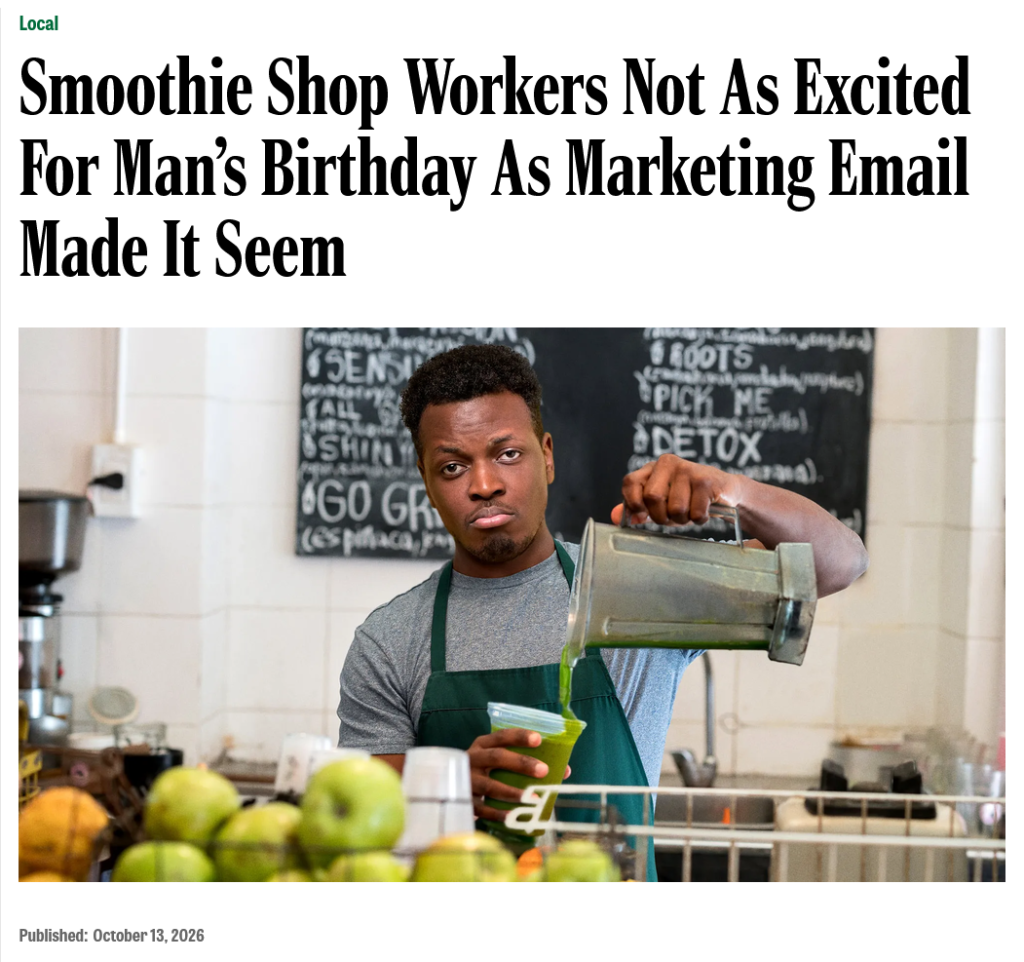
A recent article from the Onion pokes fun at email marketing.
Read the rest here.
And yes, I found this article because I’m signed up to receive emails from the Onion 🙂
A recent article from the Onion pokes fun at email marketing.
Read the rest here.
And yes, I found this article because I’m signed up to receive emails from the Onion 🙂
Personalization in email marketing is effective.
I have a lot of subject lines in my data set which look like this:
If you are an email marketer, you know what you’re looking at. These subject lines have the recipient’s name automatically inserted before the email hits their inbox, hence the {First_Name} and %%FIRST_NAME%%.
But should marketers actually personalize their emails like this? (more…)
Short answer: Yes.
Long answer:
In my research on email marketing subject lines, I found that exclamation points can increase open rates.
Moves in email marketing series
This post is a part in a series I’m calling “Moves in email marketing”. Click on that link to see the other posts in the series. The posts are based on my academic research on the topic.
The word “move” is used to describe something that the language of does, whether it offers an incentive, pressures customers into acting, or entices them to respond. This term is borrowed from academic literature on genre (most notably Bhatia’s Analysing Genre: Language Use in Professional Settings).
The language of email marketing is designed to make people act. But it does this in various ways. Today we’re going to look at the rhetorical move of “Offering incentives” in subject lines in email marketing. The term “Offering incentives” is straightforward: when the language in a marketing text indicates a sale or a bonus or some free item, then it is offering an incentive.
In my research, I found that this is the second most common tactic occurring in email marketing subject lines (the first is “Introducing the offer,” more on that in a later post). And the most common way that marketers use this rhetorical move is by indicating a discount on price. Here are a few examples with the incentives in bold:
(more…)Remember how in the last post I said that my research found that using slang and other non-standard* ways of writing is a way to increase open rates in email marketing?
You would think that I would see this happening in marketing emails, right? Right???
Nope. It is surprisingly hard to find marketers using non-standard features in email marketing subject lines. I mean it! (more…)
And all kinds of other different ways of writing.
Linguists use the term “non-standard” to describe the types of language that are not found in formal speech and writing. So what this means is slang words and phrases, intentional misspellings, grammar that isn’t considered “correct,” and even strange punctuation. Here are some examples:
ALL CAPS in email marketing, or TREAT YOURSELF
As I mentioned in my previous post about ALL CAPS and their effect on open rates, the style of writing appears to be omnipresent in marketing. It is truly difficult to find a piece of marketing that does not include some word or phrase in ALL CAPS.
Since the last post was on subject lines, let’s continue that a bit and see what ALL CAPS look like in action.
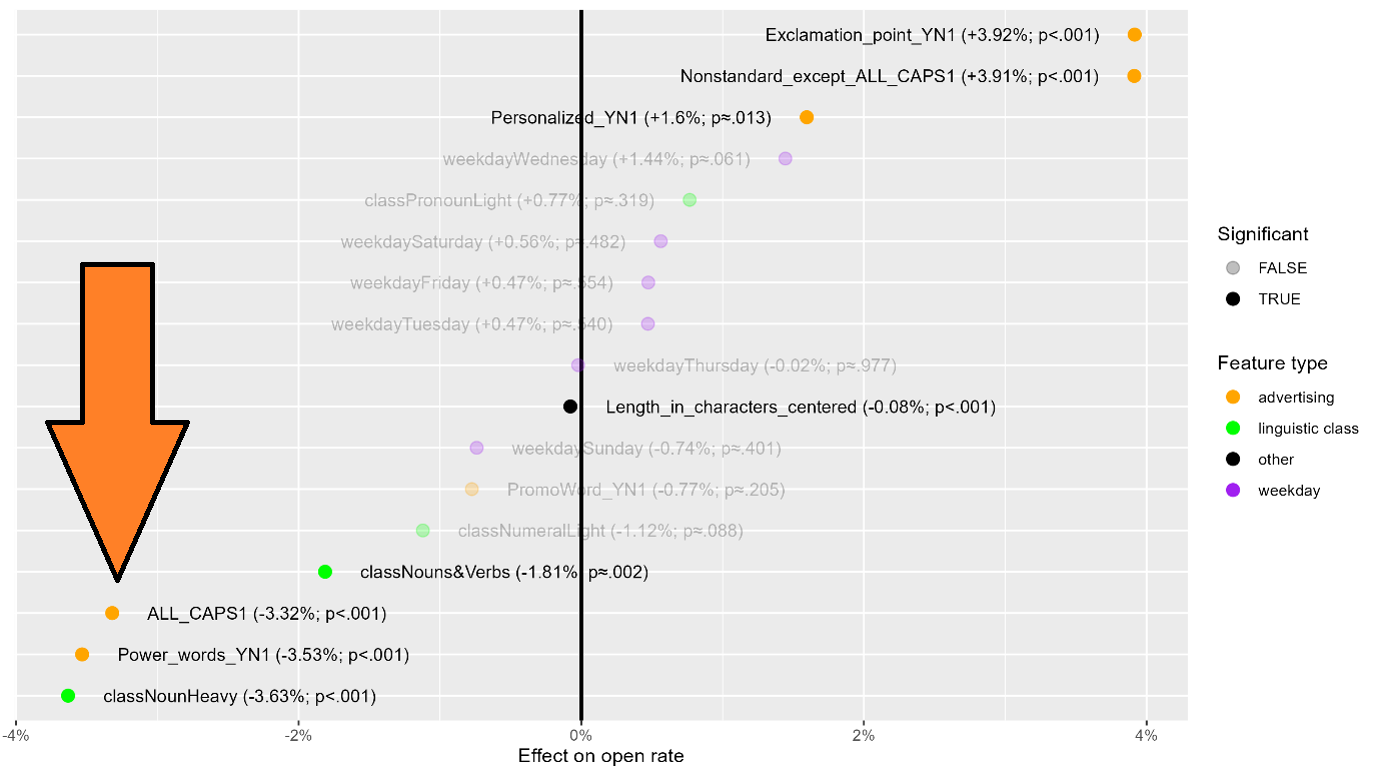
In my research, I studied whether ALL CAPS in subject lines were more or less likely to increase open rates. The findings were a bit of a surprise.
The first thing to recognize about ALL CAPS in marketing is that they are EVERYWHERE. Just take a glance at the closest piece of marketing to you right now. I’m one million percent sure that it will have some text in ALL CAPS. Why is that?
Hello and welcome this research blog: Evil Email Marketing! (It’s not really evil – that’s just a catchy title.)
I’m a linguist who researches email marketing and I’m going to use this blog to share my research with you. Some of it will confirm what you already know, some of it will surprise you, and some of it will probably be stuff you never thought of before.
The idea is that my research into the linguistic patterns of email marketing can add to the professional skills and expertise that marketers already have. So although I’ll be sharing what I’ve discovered, I would also like to hear your thoughts. Add a comment to any of the posts that pique your interest!
And if there are any linguists reading this blog, feel free to get in touch with me to discuss marketing or to collaborate. My inbox is open!
I’ll start posting next week. The look of the site might change a bit here and there while I tinker with the settings and layout.