Personalization in email marketing is effective.
I have a lot of subject lines in my data set which look like this:
- Joe, some things never change…
- JOE, Last Chance To Get 25,000 Hilton Honors Points ⏲️
- Save up to $15 through midnight, Joseph
- Hope you’re hungry, Joe
- Joe, Here’s A Hometown Gift to Say ‘HAPPY BELATED BIRTHDAY’
- Be My Valentine, Joe?
- {First_Name}, your cleansing and moisturizing kit is on its way!
- %%FIRST_NAME%%, be the first to try our organic smoothies!
If you are an email marketer, you know what you’re looking at. These subject lines have the recipient’s name automatically inserted before the email hits their inbox, hence the {First_Name} and %%FIRST_NAME%%.
But should marketers actually personalize their emails like this?
On the one hand, email marketers have been promoting this practice for decades. Like, literally, I have a book on email marketing from 2002 which tells marketers they should be personalizing their emails.
With software, personalizing emails is incredibly easy. When someone signs up to receive emails from you, they usually have to give their name. The database can then match their email with their name so that when an email goes out, the software can automatically append their name to the subject line.
The idea is that personalizing emails in this way makes readers feel like the message is coming directly to them. It’s as if they are having a personal conversation you the marketer – like in emails from friends or co-workers.
On the other hand, there is debate about whether this kind of personalizing actually works. Some studies have found that appending a recipient’s name increased the open rates of subject lines. But other studies have found that this practice is not effective. I fall in the former class, but I have some caveats.
First, the results: in my research on 31,000+ subject lines and their open rates, I found that putting the recipient’s name into the subject line increased open rates by 1.6%.
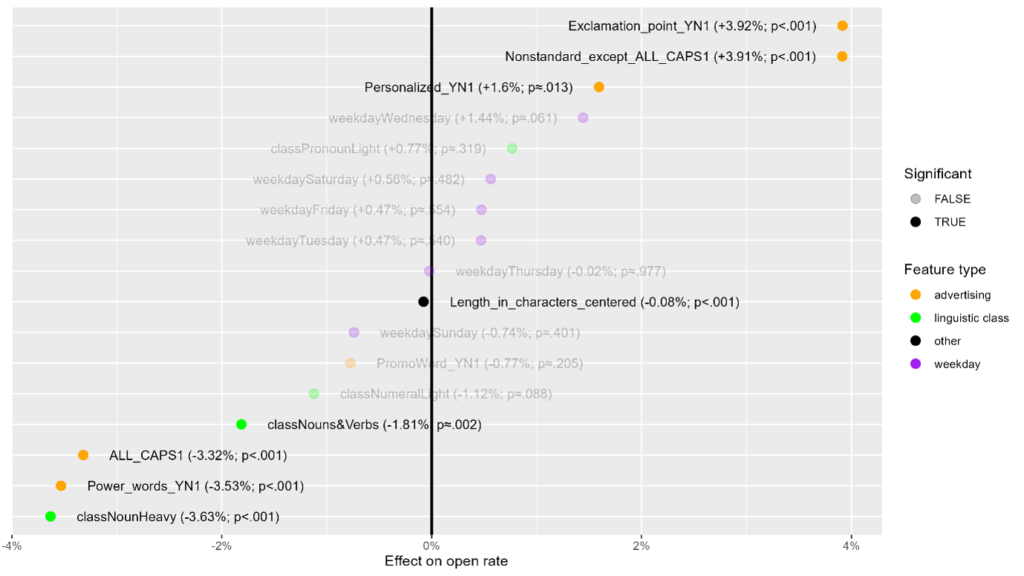
This isn’t anything to sniff at. It could mean many more people opening your emails – which means many more potential customers.
But I think that you need to consider your readers. People know what’s going on here. They know that a company is not sending a personal email directly to them. They understand that their name is automatically appended to the subject line. People can recognize a marketing email among the other emails in their inbox (something I’ll have more to say about in a later post). So if you know that personalizing the subject lines in this way is going to upset your readers, then you shouldn’t use it.
I’d recommend A/B testing this practice before adopting it wholesale. A/B testing is a good idea anyway, but it’s probably an especially good idea here.
Leave a Reply